February Washoe County Library Newsletter

wlib
Love your library in February!

Here is the Link to the February Newsletter

Highlights of events and programs include the following:

Friends of Washoe County Library Donation
Music performances by Red Chamber and M5 Mexican Brass
Historic Reno Preservation Society presents Barrie Schuster: The House that Tony Built
Idea Boxes, Story Times, Book Clubs, Senior Lifescapes and more

Posted in ArrowCreek 411, ArrowCreek411, Washoe County Library | Tagged , , , | Leave a comment

Great Jazz Concert coming to Reno on Feb 6, 2016

The legendary Jazz Trombonist Bill Watrous and premier big band arranger/conductor Gary Urwin are coming from LA to Reno to perform with the Reno Jazz Orchestra on February 6 at 7:30 PM. The RJO will be conducted by Gary Urwin, the arranger for all the songs on the program, which will be at the at Nightingale Concert Hall at UNR.

For details and tickets, go to renojazzorchestra.org

Feb6BW

Posted in ArrowCreek 411, ArrowCreek411, Reno Jazz Orchestra | Tagged , , , , , | Leave a comment

See 5 Planets At Once!

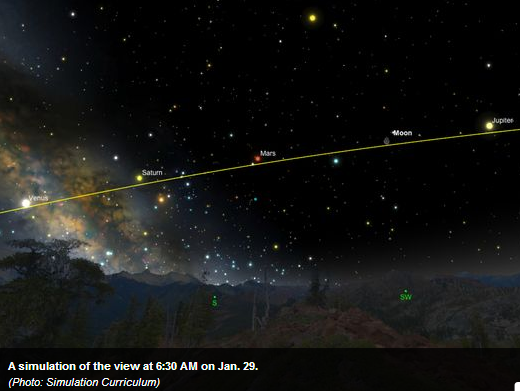
Tony Berendsen says the ArrowCreek Community will have a fantastic view of the 5 planets along the Eastern horizon right from our neighborhoods. If you’d like more instruction about it, there is an opportunity to meet with Tony and other astronomers at the UNR Redfield campus on Mt Rose Highway & Wedge Parkway across from the Raley’s shopping center around 5:30 in the morning on Wednesday, January 27, 2016. Mercury should come up over the horizon and into view around 6:20. It will be followed by the other planets.

FivePlanets

Star Guide: See 5 planets at once! (6, if you count Earth)
by Tony Berendsen

Five naked-eye planets ride the early morning sky in late January and early February. They are recast, like the characters of a Sergio Leone spaghetti Western “A Fistful of Dollars,” where Sergio portrayed western cowboys in a realistic fashion, rather than the traditional “villain wears black, hero wears white” structure of early Hollywood. As we gaze at the original five naked-eye planets over the next few weeks, we see them in new light,and with a depth of knowledge.

No longer do the planets represent mythological gods, nor does our understanding of them suffer from the crude blurry telescopic images of early planetary ground-based exploration that left many to imagine canals, vegetation, and alien civilizations. Instead the planets are cast in the stark realism of modern science. We have been to all of these planets; some of them many times. We have gone to them via robots sending back a Robert Ballard-style telepresence to our computer monitors, TVs and periodicals. Our children know them as “other worlds,” and in the near future some of them will set foot on at least one of them.

In comparison to the Earth, the planets vary wildly in size and environment. The only planet similar to our home is Mars, but even though it was once wet, it’s a very different and hostile place. Dusty, arid and cold, with almost no magnetic field to keep harmful cosmic rays and high energy particles from hitting its surface, we would not survive its surface without spacesuits and enclosed habitats.

Venus, the brightest of the naked-eye planets, is the most similar in size to the Earth. It is our closest neighbor and is even more hostile than Mars, with atmospheric pressures similar to ocean depths, lots of carbon dioxide, sulfuric acid rain, and surface temperatures so high lead would melt! The surface of Venus is completely obscured by clouds. We have only see the surface by Russian landers and radar mapping.

Mercury is the nearest planet to the Sun, and only sightly larger than our Moon. It it is a dense barren globe of rock and iron with the thinnest atmosphere of all the planets. Daytime temperatures can be as high as 800 F and because of the thin atmosphere the temperature can drop to -280 F at night.

Jupiter is the largest and second-brightest naked-eye planet. It is tremendously larger than the Earth and big enough that it could fit within its volume all the planets and the asteroids too. Jupiter is a gas giant with an atmosphere so thick that pressures would be greater than the bottom of Earth’s oceans before finding solid ground.

Saturn is the most distant of the five at almost 900 million miles from the Sun. It takes light about 8.3 minutes to travel from the Sun to the Earth, but almost 80 minutes to reach Saturn. Saturn’s rings make it the most distinctive-looking planet in the solar system. It has a low density too — so much so that if you had a cosmic ocean large enough it would float like a ringed fishing bobber.

The early morning “fistful of planets” lineup begins the last week of January and continues for the first couple weeks in February. On Jan. 29, 2016 at 6:30 AM, check out the view: Mercury on the eastern horizon, then Venus, Saturn, Mars, and Jupiter all strung along the ecliptic toward the west with the Moon in between Jupiter and Mars. Mercury can be the most difficult to find, so I suggest loading up the SkyPortal astronomy app to help. Find a vantage point with a clear view of the eastern horizon and arrive a little early to find your bearings and enjoy a rare glimpse into the solar system.

Reprinted with permission from Tony Berendsen, aka Tony the Star Guide. He runs Tahoe Star Tours. He can be reached at 232-0844 or tony@tahoestartours.com.

Posted in ArrowCreek 411, ArrowCreek411, Tahoe Star Tours, Tony Berendsen | Tagged , | Leave a comment

Nevada Caucus Information 2016

Nevada Republicans and Democrats statewide will both meet in about a month to begin the process of selecting their presidential nominees.

Since Nevada doesn’t include the race for president in its June primary, both parties use the caucus system beginning with precinct caucuses.

The Democrats are first, opening for business at 11 a.m. on Saturday, Feb. 20.

The Republicans will caucus on Tuesday, Feb. 23 beginning at 5 p.m. and ending at 9 p.m.

More info:
Washoe County Caucus Information and Links

It’s Easier Than You Think from the Reno Gazette Journal:

The Nevada Caucuses are a crucial part of the 2016 election cycle, but to some, the process can seem confusing and arcane compared to the simplicity of a paper ballot primary.

Most states use a secret ballot primary similar to the general election during the presidential nomination process, but a handful use a caucus – a system similar to a neighborhood meeting that allows voters a chance to publicly discuss the candidates and sway supporters to their side.

Nevada first gained early-state status in the 2008 cycle. The national parties wanted to expand on the Iowa Caucus and New Hampshire Primary to include a Southern and Western state. South Carolina was chosen for the South and Nevada – largely by lobbying from then-U.S. Sen. Majority Leader Harry Reid, D-Nev. – was chosen for the West.

The early-state designation encourages the candidates to visit often as they look for a way to get ahead moving into Super Tuesday, the March 1 date of more than a dozen primaries and caucuses.

“It’s our opportunity to say we’re a Western state that’s important. We’re a battleground state. We have specific issues out here that matter to Nevadans like land use,” said Greg Bailor, caucus director for the Nevada Republican Party. “It’s exciting. It’s like a test run for the general election.”

The Nevada Caucus is only used for the presidential election. It’s not like a primary where people walk in and cast their ballot throughout the day. Thirteen states and three territories use a caucus instead of a primary.

Washoe County Democratic Party Chair Cecilia Colling said a caucus functions more like a community meeting where people get together to discuss their political views and the candidates. After the discussion, they cast a ballot to allot delegates and declare a statewide winner.

“The caucus is more of an intimate relationship between neighbors where you find like ground and are able to see the enthusiasm and work with each other on ideas and so forth for the party,” she said.

The Nevada Democratic Party is holding caucus training sessions beginning at 5:30 p.m. every weeknight until Feb. 20 at Washoe County headquarters located at 1465 Terminal Way #1.

The Republicans are holding theirs at their Washoe County headquarters at 3652 S. Virginia St. Suite C-8 on the following dates:
Jan. 28 at 6:30 p.m.
Jan. 30 at 10 a.m.
Feb. 3 at 6:30 p.m.
Feb. 6 at 10 a.m.
Feb. 9 at 6:30 p.m.
Feb. 16 at 6:30 p.m.
Feb 20 at 10 a.m. and 2 p.m.

Both parties recently released websites for voters to find their caucus sites. Both sites expect you to enter your information to get the caucus information. The Republicans want name, birthday/date, email address and city & Zip. The Democrats will just take your address.
The Democrats’ website is at http://nvdems.com/caucus/locations/
The Republicans’ website is at http://bit.ly/1n6YAns

More info from the 24 Jan 2016 Nevada Appeal article by Geoff Dornan:

WHAT IS A CAUCUS

To many, the caucus system is confusing and can be frustrating. It’s significantly more complicated since each party sets its own rules using just general guidelines in statute. But there are important differences between how the two parties do things.

A caucus is probably best described as a gathering of fellow party members to discuss politics and select delegates to the county conventions. They also will discuss issues to include in their respective party platforms.

Typically, they are held in multiple locations at area schools, community centers and even churches. Voters are invited to attend the meeting for their specific precinct, which they can figure out online or by looking on their voter registration card. In Carson City this year, there are two locations for Republican caucuses and four for the Democrats.

After attendees sign in, there are some formalities including local party business such as the election of central committee members. Then, those in attendance break into groups representing the different candidates.

HOW DELEGATES ARE SELECTED

At this point, things start to get a bit more complicated.

First, by state law, each precinct at the caucus gets one delegate for every 50 voters registered with their political party. If Democrats have 150 registered voters in a precinct, that precinct picks three delegates to their county convention.

If Republicans have 200 registered in a precinct, that precinct’s caucus gets four delegates to the GOP county convention.

The Democrats assign their caucus delegates to the presidential candidates proportionally according to their support at the caucus. Supporters of candidates who can’t raise enough backers to qualify for a delegate can then shift their allegiance to another candidate. But McGarry said those people also could unite and form a group of “undeclared” delegates.

That process means there are a large number of delegates chosen for the county conventions. Those delegates pick state convention delegates and, importantly, they can change their mind on who to vote for. They then pick Nevada’s 43 Democratic delegates to the national convention and those delegates are bound to vote for the person they represent — on the first national convention ballot. After that, they can change their mind.

The Republicans do it differently. They conduct a presidential preference vote at their caucuses to apportion their 30 national convention delegates among the different candidates.

Each county’s vote results are put together by the state party to determine who gets how many of those slots.

County convention delegates are chosen independently of that preference vote and, again, there are many more of them than the party finally chooses to send to the national convention. But, if a candidate gets 55 percent of the caucus vote, that candidate gets 55 percent of the delegates all the way through the process to the national convention.

That rule applies on the first ballot. After the first ballot, they, like the Democrats, are free to change their mind.

Because they are “bound” only on the first ballot and because national delegates must have participated in the caucuses, county and state conventions, Republican Party activist Carol Howell says it’s important not only to attend the caucus and vote but to participate in picking delegates.

“It’s important that people, especially strong supporters, start at the precinct meetings and go through the county and state to the national convention,” Howell said.

Otherwise, she said, small factions representing less popular candidates may lock up a disproportionate number of delegates early on. That’s what happened to the Nevada GOP in the 2008 and 2012 election cycles when delegates weren’t bound to their stated candidate at the county or state level.

OTHER DIFFERENCES

Another difference is while people can register as a Democrat on the day of the caucuses, Republicans must have been registered with the party at least 10 days before the caucuses. Both parties allow 17-year-olds who will be 18 before election day to participate in the caucuses and conventions.

Democrats also have a system of rules designed to ensure diversity among their delegates ranging from gender and gender identity to ethnicity, disability and age. The GOP doesn’t have those requirements.

Both parties provide a way for military members and families who can’t attend to caucus. Democrats also allow shift workers unable to attend to do so.

Democrats have set their county conventions for April 2. The Republicans will hold theirs April 9.

Both parties plan their state conventions for May 14-15.

Posted in ArrowCreek 411, ArrowCreek411, Nevada Caucus | Tagged , , | Leave a comment

Lake Tahoe Restoration Act Passes Committee

From carsonnow.org on Wed, 01/20/2016 – 9:24am

The Lake Tahoe Restoration Act of 2015, a bipartisan bill sponsored by Nevada Sen. Dean Heller, passed the U.S. Senate Committee on Environment and Public Works on Wednesday. The legislation, created alongside senators Dianne Feinstein, D-Calif., Harry Reid, D-Nevada and Barbara Boxer, D-Calif., provides federal, state, and local partners important tools to reduce wildfire threats, improve water clarity, jumpstart innovative infrastructure projects, and combat invasive species.

“As a lifelong Nevadan and an avid outdoorsman, I grew up enjoying Nevada’s beautiful outdoors, such as Lake Tahoe. Today’s committee passage is a big step toward combating the numerous threats that take a toll on the Tahoe Basin,” said Sen. Heller. “I look forward to working with our delegations in both the Senate and the House to resolve the discrepancies between the two different Tahoe proposals and enact a bill that helps conserve the Basin’s natural beauty for generations to come.”

The Senate and the House both have bills before their members called the “Lake Tahoe Restoration Act.” But going about protecting the lake’s cobalt blue waters varies with political interests wanting less money spent on water clarity issues and more spent on fire protection and forest management.

Heller and Feinstein, both spoke at the annual Lake Tahoe Summit in August, showing bipartisan support of the Senate version that calls for $415 million to be spent on preserving Lake Tahoe.

Sen. Reid made the following statement:

“Since 1997, when we held the first Lake Tahoe Summit with President Bill Clinton, we have made incredible strides in restoring the health and famed clarity of Lake Tahoe’s waters. With the passage of the first Lake Tahoe Restoration Act in 2000, we have been able to accomplish so much. Major forest restoration and fuel breaks have been completed to lessen the impact of wildfire on the lake itself and the community that surrounds it.


Marshlands and wildlife habitat around the lake have been restored and improved. Pollution from stormwater and transportation that was clouding the lake’s clear blue waters has been mitigated. The Lahontan Cutthroat Trout, which had disappeared from the lake in 1939, is on its way to recovery. We have made significant progress in restoring our Jewel of the Sierras, but there is still much more that needs to be done. This bill is vital to ensuring that the work of protecting Lake Tahoe and the Tahoe Basin continues uninterrupted.


“But this legislation does more than simply carry these existing programs forward. This bill focuses our investments by making science a priority, calls for better management of our public lands in the Lake Tahoe Basin and better public access to those lands, and takes aggressive action against new threats, specifically algae growth and the spread of aquatic invasive species such as quagga and zebra mussels. We have seen the threat of quagga and zebra mussels in Lake Mead in southern Nevada. Quagga mussels, which were discovered in Lake Mead for the first time in 2007, now number in the trillions. They clog water intake pipes, cover beaches with sharp shells and compete with native species for nutrients. We must do everything we can to prevent Lake Tahoe from befalling a similar fate.


“I would like to thank the coalition of people and organizations in Lake Tahoe who have proven to be a model of cooperation. The local residents, federal employees, town and county representatives, the Tahoe Regional Planning Agency, the business community and the non-profit community in the Lake Tahoe Basin have demonstrated the impact that federal funding paired with state and local resources can have. The partnership to protect Lake Tahoe works and we should continue to invest in that partnership with this legislation. By guarding against pollution, wildfires and invasive species, we can ensure that the Jewel of the Sierras continues to be a thriving tourist destination for those who enjoy Lake Tahoe’s crystal clear waters for many years to come.”


The Lake Tahoe Restoration Act addresses:

— Wildfire Prevention – Provides $150 million for fire risk reduction and forest management. These dollars go toward fuel reduction projects in high-risk areas like South Shore, Carnelian Bay, Incline, and West shore stewardship contracts to restore forest health and wildlife habitat, and municipal water infrastructure to support improved flows for firefighting.

— The Environmental Improvement Program (EIP) – Provides $80 million to jumpstart projects spanning from new bike trails to creek restoration and fire treatment. Some previous EIP projects that have benefited the region include the Heavenly Gondola and Village, the Angora Fire rehabilitation, Lake View Commons, the Sand Harbor Visitor Center, and the Incline Creek Restoration.

— The Invasive Species Management Program – Provides $45 million to prevent the introduction of the quagga mussel and manage other harmful invasive species like the Asian clam. This includes lake-wide aquatic invasive species control and a watercraft inspection program.

— Stormwater Projects – Sets aside $113 million to implement storm water management, erosion control, and watershed restoration projects. Storm water runoff from roads and the urban areas in the basin, vehicle exhaust, altered wetlands and streams, and inadequate storm water pollution control have significantly impacted Lake Tahoe’s famous clarity.

— The Lahontan Cutthroat Trout Recovery Program – Allocates $20 million to recover the Lahontan cutthroat trout – a federally threatened species and Nevada’s state fish.

— Increases Accountability and Oversight – Provides $5 million to ensure projects will have monitoring and assessment in order to determine the most cost-effective projects and ensure dollars are properly utilized.

— Overall Management Improvement – Sets aside $2 million to cover the cost of land exchanges and sales on both the California and Nevada sides of the Tahoe Basin that will improve efficiencies of public land management.

The federal government owns nearly 80 percent of the land in the Lake Tahoe Basin, creating a significant responsibility for its agencies to contribute to the ongoing management of its natural resources. The $415 million authorized under the Senate bill ensures the federal government’s share of this responsibility is met.

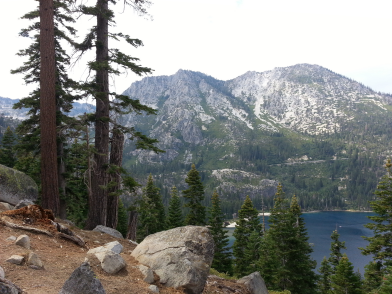
20130819LakeTahoe

Posted in ArrowCreek 411, ArrowCreek411, CarsonNow, Lake Tahoe Restoration Act | Tagged , , | Leave a comment

January 21 2016 FACT Update From Washoe County Assessor Records

Here are January UPDATED ‘FACTS’ from the Washoe County Assessor Records since the Dec 21, 2015, ArrowCreek411 posting December Fact Update From the Washoe County Assessor Records.

For those who continue to believe that property on the golf course is worth 28% more than property NOT on the golf course, here are the FACTS:

  1. ArrowCreek properties continue to sell in the premium class within Washoe and Douglas Counties as previously reported in our December update. For the year that we’ve been tracking:

    a.) Ninety-three (93) properties were recorded sold in ArrowCreek between 17 December 2014 and 14 January 2016 or 8.6% of ArrowCreek properties changed hands this past year (This according to the Washoe County Assessor).

    b.) Twenty-six (26) of those properties were on the golf course (the property boundaries actually touch the golf course, not just have a ‘view’ of it). Twenty-two (22) of those were homes with an average selling price of $227.11 per square foot. This is a decrease of $2.60 per square foot from December’s value. No additional vacant lots were sold and the average selling price of $207,104.47 per acre remained.

    c.) Sixty-seven (67) properties were sold that are not connected to the golf course. Fifty-two (52) of those properties were homes with an average selling price of $235.73 per square foot. This represents an increase of $1.98 per square foot from the December report. Fifteen (15) properties were vacant lots with and average selling price of $154,878.51 per acre, an increase of $1,924 per acre (or 1.2%) over the December value.

    d.) Homes that do not have a boundary with the golf course continue to sell at a premium and appear to be more stable than those on the golf course. Both values appear to be following the market trends where upper end home values are trending downward or stay on the market an extra-long period of time (this is true in both Douglas and Washoe counties).

    e.) There was one lot sold but a premium remains if the lot has a common boundary with the golf course. This value between the two categories in general appears to be following market trends. However, there’s little explanation for the $52,225 difference between the vacant lot purchase prices, as the difference does not show up in the closing home sales prices.

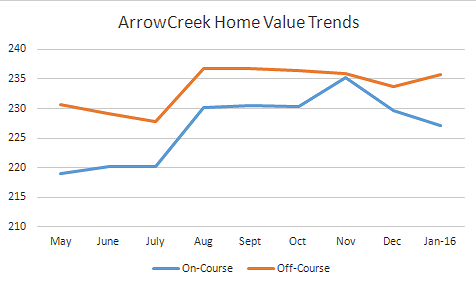
    f.) The trends for our property values indicate that over the past seven months of tracking, the values of homes off the golf course are fairly stable, with the gap between homes on and off the course again showing an increased margin. Note, however, that both values are clearly above what they were when we started tracking the values back in May 2015.

  2. AC Jan16 DolPerSqFt

  3. The primary mission of the ACHOA Board is to maintain or increase property values within our subdivision. In spite of the events of this past year, it’s clear from the chart of ArrowCreek Home Values that indeed our properties are worth more today than they were in May 2015.

Going forward let’s focus our energy on improving the amenities we currently have and build out those that were in the original ArrowCreek development plan by using our already available acreage and funding.

If you wish to support The Club at ArrowCreek, you’re urged to become either a full golf or social member. In addition, the FOA LLC is certainly open to new investors.

By Ron Duncan

Updated from Dec 22, 2015 posting December Fact Update From the Washoe County Assessor Records

… which updates the Nov 22, 2015 posting November Fact Update From the Washoe County Assessor Records

… which updates the Oct 19, 2015 posting October Fact Update: Here Are Facts

… which updates the Sept 21, 2015 posting September Fact Update: Here Are Facts

… which updates the Aug 22, 2015 posting August Fact Update: Here Are Facts

…which updates the July 27, 2015 posting July Fact Update: Here Are Facts

…which updates the June 26, 2015 posting June Fact Update: Here Are Facts

…which updates the June 4, 2015 posting You Want Facts: Here Are Facts.

June 2015 Study on Golf Course Closure Impacts On Home Values in Northgate and D’Andrea.

Posted in ACHOA, ArrowCreek, ArrowCreek 411, ArrowCreek411, Brian Bonnenfant, Home Sales, Home Values, Land Use, Land Value Study, Property Value | Tagged , , , , , , , , , , , , , , , , , , | 13 Comments

Somersett Golf and Country Club to Begin Clubhouse Construction

Somersett United captured the Reno Gazette Journal article and comments here: SGCC Clubhouse Construction

Here is the RGJ article:
sgcc-clubhouse

Posted in SGCC, Somersett, Somersett United | Tagged , , , , , | Leave a comment

First Official 2016 ACHOA BOD Meeting Set For Feb 16

ACArrow

All owners are invited and encouraged to attend board meetings.

ACHOA BOARD MEETING
Tuesday February 16, 2016
6:00 PM-8:00 PM **** NOTE LATER TIME ****

Location: ACHOA Resident’s Club


This is the first official 2016 board meeting of the new ACHOA Board. In addition to setting goals and directions, committee appointments will be an action item on this agenda. If you are interested in serving on one of the many committees, please let the HOA know. All the committee charters, members, and the Committee Interest Form are posted on the http://www.arrowcreek-hoa.com website. Please note, you must login to view the Charters.

Posted in ACHOA, ACHOA BOD, ArrowCreek, ArrowCreek 411, ArrowCreek HOA, ArrowCreek411 | Tagged , , , , , , , | Leave a comment

Washoe County Announcement: Safe Sleep Environment for Babies

REMSA and Washoe County Social Services reminds families to create a safe sleep environment for children. There have been four infant fatalities in a six-week period between Oct. 23 to Dec. 8, 2015, in Washoe County. “This alarming trend in infant deaths is compacted due to the fact it is preventable by creating safe sleeping environments for children.”

Read more here: Safe Sleeping

Posted in REMSA, Washoe County | Tagged , , , , | Leave a comment

SPC Report on TCTC Amenities and SGCC Land Usage

This is an interesting discussion for those ArrowCreek residents still interested in land use issues in Reno and in Washoe County.

Source: SPC Report on TCTC Amenities and SGCC Land Usage

Posted in ArrowCreek 411, ArrowCreek411, Land Use, SOA, Somersett, Somersett United | Tagged , , , , , , , | Leave a comment